The Reason Edouard Manets Painting Is Important in the History of Art and Photography Is Because
In the 19th century, several major art movements emerged in Europe, including Realism and Impressionism. Though drastically different in style, this pair of genres had one important artist in common: Édouard Manet. Manet's groundbreaking work both blurs the line and bridges the gap between the distinctive movements, with the globe-famous Olympia serving as a key example.
Through a contemporary lens,Olympia is embraced as an important precursor to mod art. However, when Manet revealed this piece at Paris' prestigious salon, both its field of study thing and style caused an unprecedented stir. Ironically, information technology is this scandal that would play a pivotal role in the painting'due south eventual fame and that would help put Manet's name on the map.
Manet'south Early Work

Édouard Manet, "Music in the Tuileries," 1862 (Photo: Wikimedia Commons Public Domain)
In 1850, French painter Édouard Manet launched an art career in Paris. At this time, he worked in the studio of academic painter Thomas Couture and spent his time copying masterworks in the Louvre. With such traditional influences, it is no wonder that Manet'south early work typically favored religious, mythological, and historical subject matter.
In 1860, all the same, Manet'southward piece of work began to hint toward a new and avant-garde approach. With works similar The Spanish Vocaliser andMusic in the Tuileries—painted in 1860 and 1862, respectively—he abandoned conventional iconography in favor of contemporary subjects. While these works were met with by and large positive reviews by critics, his work the following year would turn the art world on its head.
In 1863, Manet completed two significant works:The Dejeuner on the Grass andOlympia. Featuring nude female person figures from everyday life rendered realistically and on a large scale, these works were unprecedented. While The Dejeuner on the Grass was rejected past theAcadémie des Beaux-Arts, the system responsible for France's annual art salons, Olympia was accustomed—though its exhibition was not without controversy.
Olympia
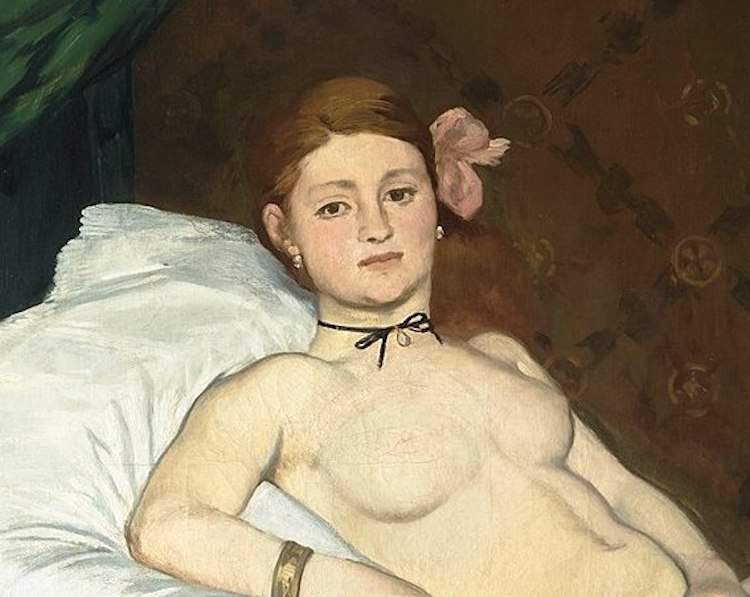
Édouard Manet, "Olympia," 1863 (item)
Subject Matter
Olympia features 2 figures: a nude (modeled after Victorine Meurent, who also posed for The Lunch on the Grass) lounging on a bed and a servant continuing at its foot. Both the reclining figure's nudity and position allude to by works, including Venus of Urbino, a Renaissance painting by Titian; Ingres' Odalisque with a Slave; and The Nude Maja, one of Francisco Goya's nearly famous paintings.
Unlike these past works, withal, Olympia was reviled for presenting the "cold and prosaic reality of a truly contemporary subject field." This reaction was primarily fueled by three characteristics of the painting. The first is that Olympia, the nude effigy, was intended to exist a prostitute—an element emphasized past the symbolic presence of a black cat and a bouquet of flowers.
The 2nd, surprisingly, is her accessories; the blackness ribbon she wears on her neck, the orchid in her hair, and her slung-off shoe accentuate her nudity while simultaneously illustrating Olympia's own comfort with her lifestyle.
Lastly, the figure's self-bodacious and straight-alee gaze was viewed equally controversial. Too axiomatic inThe Tiffin on the Grass, Manet'due south inclusion of a female person nude with a "calculating expect" was strategic, every bit information technology connects the viewer to the sheet and allows them to engage with Olympia.
Reception
In add-on to its blatant sexual undertones, critics were displeased by Manet's realistic rendering of the effigy, whose coloring was compared to "the horror of the morgue" and whose easily and feet were referred to as "dingy" and "wrinkled," respectively.
It is this authenticity, however, that garnered the approval of Manet's friends and boyfriend creatives. "When our artists give us Venuses, they correct nature, they prevarication," writer Emile Zola said in 1863. "Manet asked himself why lie, why not tell the truth; he introduced u.s. Olympia, this fille of our fourth dimension, whom yous meet on the sidewalks."
Manet's determination to describe an everyday person in an ordinary setting is what placed him at the forefront of both the Realist and Impressionist movements. Though he believed his work more closely resembled Realism, he began working and exhibiting with the Impressionists in 1868, culminating in a career-long relationship with the movement.
"When you await at it," Manet remarked about a painting's subject, "and above all, when you run into how to render information technology as you lot see it, [that] is, in such a way that [it makes] the aforementioned impression on the viewer every bit information technology does on y'all."
Olympia Today
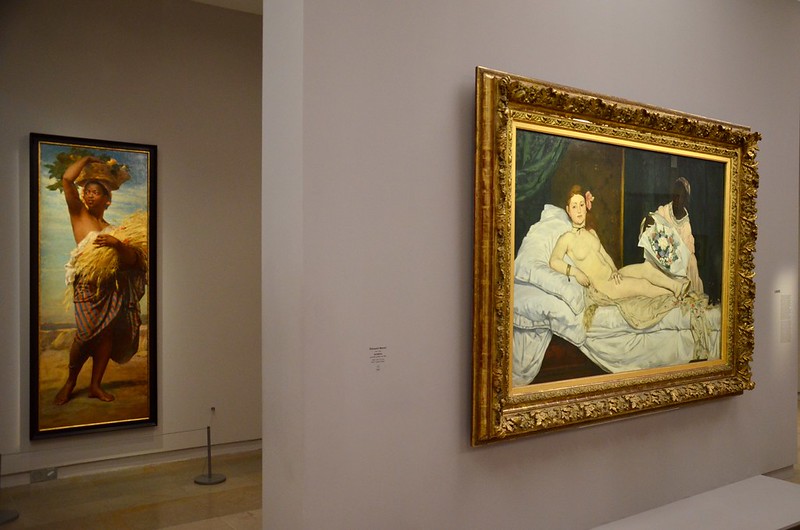
Along with The Dejeuner on the Grass, Olympia currently hangs in Paris' Musée d'Orsay. While it has been a tried and true highlight of this museum for decades, it continues to inspire new debates and dialogues.
Specifically, the role of the black servant—modeled afterwards a adult female named Laure—has finally come into the spotlight. Following a string of studies on Laure, the Musée d'Orsay has made her a focal point of Black Models: from Géricault to Matisse, a recent large-scale exhibition. Taking a multi-disciplinary approach to a multi-layered concept, Blackness Models explored the role of Laure and other black figures in art in order to offer an unprecedented look at the "aesthetic, political, social and racial bug as well as the imagery unveiled by the representation of black figures in visual arts."
Related Articles:
8 Facts Almost Picasso's Groundbreaking Painting 'Les Demoiselles d'Avignon'
The Story Backside Renoir's Impressionist Masterpiece 'Luncheon of the Boating Party'
eight Real-Life People Who Became the Stars of Fine art History's Almost Famous Paintings
20 Art History Terms to Aid You Skillfully Describe a Work of Art
Source: https://mymodernmet.com/edouard-manet-olympia/
0 Response to "The Reason Edouard Manets Painting Is Important in the History of Art and Photography Is Because"
Post a Comment